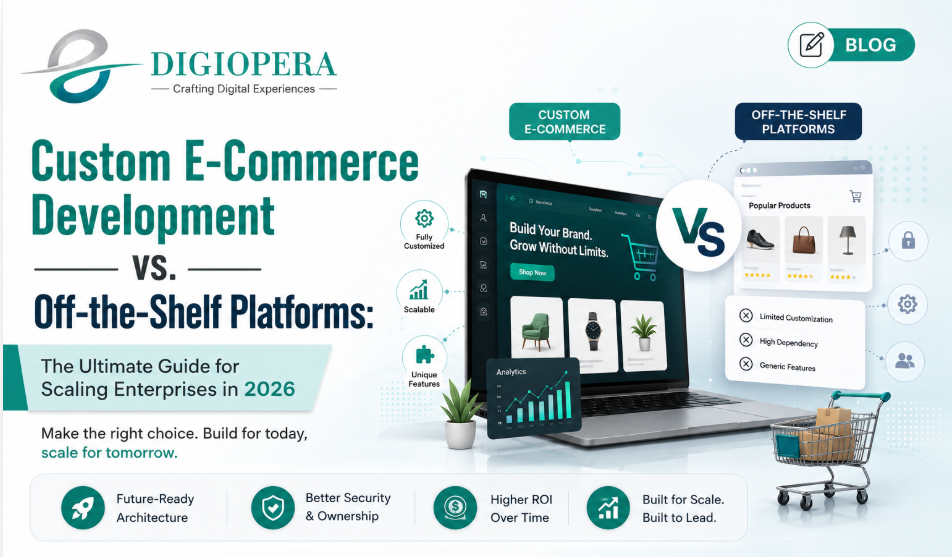
Introduction: The Digital Commerce Crossroads
In the rapidly evolving digital marketplace, selecting the architectural foundation for your online store is one of the most critical decisions a business leader will ever make. It is no longer just about choosing a tool to display products and process transactions; it is about building a scalable digital engine that dictates your operational efficiency, user experience, and long-term profitability.
As enterprise brands aim to dominate global markets, the fundamental question arises: Should you build a custom e-commerce solution from scratch, or should you rely on established off-the-shelf platforms?
Many businesses mistakenly view this purely as a financial decision—comparing upfront setup costs against monthly subscription fees. However, the reality runs much deeper. It involves evaluating architectural control, technical debt, checkout friction, data sovereignty, and cross-border agility. This comprehensive guide provides an international-level comparison between Custom E-Commerce Development and Off-the-Shelf Platforms (SaaS & Open-Source) to help your business make a future-proof choice.
---Understanding the Contenders: Definitions and Core Philosophies
Before diving into the granular points of comparison, it is essential to establish a clear understanding of what each architectural path truly represents.
1. Custom E-Commerce Development
Custom development implies designing, engineering, and deploying a tailor-made e-commerce ecosystem specifically engineered for your unique business workflows. It doesn't rely on restrictive commercial themes or monolithic platform cores. Instead, it leverages modern frameworks (such as Next.js, React, Node.js, Python, or Go) and often utilizes a Headless Commerce or microservices-based architecture.
With a custom setup, the front-end user experience (the storefront) is completely decoupled from the back-end business logic. Every API endpoint, database schema, and micro-interaction is written to align perfectly with your operations.
2. Off-the-Shelf Platforms (SaaS & Open-Source)
These are pre-built, ready-to-deploy digital commerce environments that fall into two main sub-categories:
- SaaS (Software-as-a-Service): Platforms like Shopify Plus or BigCommerce. You pay a recurring license fee, and the platform handles hosting, basic security, and core updates. You trade architectural control for speed to market.
- Traditional Open-Source: Platforms like Magento (Adobe Commerce) or WooCommerce. The core code is accessible, allowing for significant customization, but it remains a monolithic framework requiring heavy infrastructure management, security patching, and constant optimization.
The Core Pillars of Comparison
1. Architecture, Flexibility, and Design Freedom
The layout and performance of your storefront directly influence your conversion rates. If your tech stack limits your user experience, your brand perception suffers.
Off-the-Shelf Platforms: Pre-built platforms operate within defined structural frameworks. While themes allow you to change colors, typography, and structural blocks, you are fundamentally bound by the platform's core design engine. If you want to build a deeply immersive, gamified shopping experience or a complex multi-layered product configurator, you will often hit a technical brick wall or face severe performance degradation due to bloated plugin dependencies.
Custom E-Commerce: Custom development offers absolute creative and structural autonomy. Because the frontend is decoupled, developers can craft highly intuitive, lightning-fast interfaces using modern UI/UX components. Whether it is an innovative voice-assisted search, personalized dynamic styling based on user behavior, or a complex B2B client portal with unique corporate account hierarchies, custom code can deliver it flawlessly without relying on restrictive template logic.
2. Scalability and Global Performance (Speed is Revenue)
Data consistently proves that a one-second delay in page load time can reduce conversions by up to 7-10%. Scalability is not just about surviving peak holiday traffic; it is about keeping performance consistent worldwide.
- SaaS Scale Limitations: SaaS providers handle server loads reasonably well, but they rely on shared infrastructure. If you have highly customized workflows running through third-party apps, your checkout sequence can slow down during flash sales, costing you thousands in abandoned carts.
- Open-Source Monolith Bottlenecks: Systems like Magento require complex, expensive database clustering, caching layers (like Varnish and Redis), and dedicated DevOps teams to handle millions of monthly visitors without crashing.
- The Custom Edge: Custom systems built on microservices can leverage serverless infrastructures (like AWS Lambda or Vercel Edge Networks). Different parts of your platform scale independently. For instance, if your product browsing traffic spikes by 500%, only the product catalog microservice scales up dynamically, while the checkout and payment systems remain light and unaffected. This ensures near-zero downtime and blazing-fast global load speeds.
3. Total Cost of Ownership (TCO) & Long-Term ROI
Business owners often overlook the hidden, ongoing expenses associated with "easy-to-start" software models.
The Illusion of Low-Cost Platforms: While starting a basic Shopify or WooCommerce store requires a relatively minor initial investment, the costs compound dramatically as an enterprise scales. Consider the enterprise equation:
High Monthly Licensing Fees + Per-Transaction Fees (0.5% to 2% on non-native gateways) + Premium App Subscriptions + Custom Developer Maintenance Retainers = A Highly Inflated Operational Expense.
Over a 3- to 5-year timeline, an enterprise might end up paying hundreds of thousands of dollars in recurring platform taxes without owning a single line of the intellectual property.
The Custom Investment Realism: Custom development demands a significant upfront capital expenditure (CapEx) for discovery, UI/UX architecture, engineering, and testing. However, once built, the ongoing operational expenditure (OpEx) drops dramatically. You only pay for standard cloud hosting infrastructure (AWS/Azure) and periodic feature updates. Most importantly, the platform is a proprietary digital asset that directly boosts your company’s valuation.
---Comparative Overview Table
Let's look at a clear technical breakdown of how these approaches contrast against each other across core metrics:
| Feature/Metric | Custom E-Commerce Development | Off-the-Shelf Platforms (SaaS/Open-Source) |
|---|---|---|
| Initial Time-to-Market | Moderate to High (typically 3 to 6 months of development) | Fast (Weeks for basic setups using existing themes) |
| Design & UX Flexibility | Unlimited. Custom UI components built from scratch. | Restricted by theme structures and core layout engines. |
| Ongoing Licensing Fees | Zero. You own the software completely. | High monthly tiers + revenue share or transaction cuts. |
| Performance & Page Speed | Optimized using lean, modern headless frameworks. | Can slow down due to theme bloat and heavy third-party plugins. |
| Third-Party Integrations | Direct, seamless API connections tailored to your ERP/CRM. | Dependent on pre-existing marketplace plugins or complex wrapper APIs. |
| Security Control | Military-grade custom firewalls, isolated databases, custom access control. | Dependent on platform core patches or vulnerable third-party apps. |
Deep-Dive: Integrations, Legacy Systems, and Ecosystem Control
Modern e-commerce stores do not operate in a vacuum. They must continuously sync data with Enterprise Resource Planning (ERP) systems (like SAP, NetSuite, or Microsoft Dynamics), Customer Relationship Management (CRM) tools (like Salesforce), Warehouse Management Systems (WMS), and complex Supply Chain systems.
When using an off-the-shelf platform, you are forced to use middleware connectors or marketplace apps to bridge your store with your backend operations. If your ERP has highly specific custom fields or handles specialized bulk wholesale pricing rules, pre-built integrations often fail. Developers are then forced to write complex "hacky" code layers to override the platform's standard behavioral limits.
Conversely, Custom E-Commerce Development treats integration as a first-class citizen. APIs are built natively to match your precise data mapping schemas. Product data, real-time omni-channel inventory levels, localized B2B tier pricing, and logistics updates flow smoothly across all organizational touchpoints without any risk of data synchronization lag or system failure.
---Security, Compliance, and Data Sovereignty
Data breaches, ransomware attacks, and credential stuffing are major threats in global digital commerce. Furthermore, strict compliance mandates such as GDPR (Europe), CCPA (California), and PCI-DSS require stringent data handling protocols.
The Vulnerability of Mass Platforms: Popular open-source platforms are continuous targets for global hackers. Because millions of stores run on the exact same open core code, a newly discovered vulnerability in a widely used plugin can expose thousands of sites simultaneously overnight. Merchants must enter a constant cycle of applying security patches, upgrading PHP versions, and scanning for malware injections.
The Security Profile of Custom Builds: Custom systems are naturally more resilient to mass automated exploits because their architecture is unique and completely proprietary. There is no public documentation detailing their internal directory structures or database vulnerabilities. Security teams can implement highly targeted security parameters: specialized tokenization strategies, custom multi-factor authentication systems, data isolation protocols, and custom web application firewalls (WAF) optimized for your explicit traffic patterns.
---Strategic Decision Matrix: Which Path is Right For You?
To conclude, there is no single right answer, but there is always a correct strategic choice based on your current operational maturity and business objectives.
Choose an Off-the-Shelf Platform if:
- You are a startup or early-stage brand validating your product-market fit.
- Your direct operational workflows match standard retail and checkout patterns perfectly.
- You lack a dedicated internal technical team or a long-term specialized development agency partner.
- You need to launch a functional digital store within a matter of a few weeks.
Choose Custom E-Commerce Development if:
- You are an enterprise organization managing multi-million dollar annual revenue and require full ownership of your technology assets.
- You run complex business models like B2B wholesale portals, multi-vendor marketplaces, D2C hybrid setups, or subscription ecosystems with highly custom logic.
- You require deep, real-time integration with legacy on-premise or cloud enterprise architectures (ERP, CRM, complex accounting).
- You want an uncompromised, hyper-fast, next-generation user experience that positions your brand at the absolute cutting edge of your industry.
Final Thoughts: Future-Proofing Your Digital Enterprise
Your digital storefront is the virtual face and primary revenue vector of your enterprise. While pre-built platforms offer a convenient entry point for growing brands, they ultimately introduce operational ceilings, high recurring transaction costs, and rigid architectural constraints that can limit an enterprise's true potential.
Investing in custom e-commerce development means investing in limitless scalability, tailored customer experiences, and absolute digital sovereignty. By building a fast, integrated, and completely proprietary commerce engine, you prepare your brand to scale seamlessly, pivot rapidly, and outperform competitors in the global digital landscape.
Want to discuss your project? Book a free consultation →